
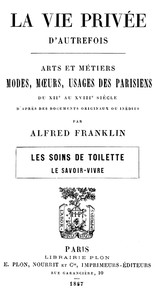
La vie privée d'autrefois; Arts et métiers, modes, moeurs, usages des parisiens…
Alfred Franklin’s La vie privée d'autrefois (The Private Life of the Past) isn't a novel with a plot in the traditional sense. Its "story" is the slow, detailed unfolding of daily existence across five centuries of Parisian history. Franklin, a librarian and historian, acts as a meticulous collector. He pieces together the narrative of everyday life from sources most historians overlooked: old trade manuals, guild regulations, household account books, police records, and forgotten pamphlets.
The Story
Think of this book as a series of interconnected vignettes. One chapter might explain the complex, often dangerous process of making candles or soap. The next pulls you into the noisy, chaotic world of the medieval marketplace, detailing the specific cries used by vendors selling fish, bread, or used clothes. Franklin charts how Parisians built their homes, what they ate (and how they cooked it without modern stoves), how they dressed for work and for court, and even how they navigated the dark, unpaved streets at night. He shows the evolution of tools, fashions, and social customs, creating a vivid, almost tangible sense of a city in constant, gritty motion.
Why You Should Read It
What makes this book special is its focus on the how and the why of ordinary things. It answers questions you didn't know you had. You gain a profound appreciation for the sheer effort behind every aspect of pre-industrial life. It’s also surprisingly intimate. Reading about the strict rules of a baker's guild or the precise layout of a 17th-century kitchen makes history feel immediate and personal. These weren't just "people of the past"; they were individuals solving problems, following trends, and trying to make a living, just like us. Franklin’s work quietly dismantles the idea of the "dark ages" or a static past, revealing instead a world of innovation, noise, color, and relentless human energy.
Final Verdict
This book is a treasure for a specific kind of reader. It’s perfect for history lovers who are tired of reading about kings and want to meet the common people. It’s ideal for writers or artists looking for authentic period details to flesh out a story or painting. If you love museums and wish the exhibits could talk, this is your book. A word of caution: it’s a detailed, scholarly work, so it’s best taken in small, savory bites rather than read in one sitting. Dive in for fifteen minutes and you’ll be transported to a Paris built not of stone, but of daily routines, skilled hands, and the smoke of a thousand hearths.
This work has been identified as being free of known copyright restrictions. Feel free to use it for personal or commercial purposes.








Sandra Gonzalez
3 months agoI had low expectations initially, however the narrative structure is incredibly compelling. Don't hesitate to start reading.